Across defence, transport, AI and emerging technology programmes, one pattern appears repeatedly. Many organisations invest enormous effort into solving the technical problem — developing new algorithms, new architectures, new platforms, new infrastructure or new capabilities.
But technical success alone is rarely enough. The harder challenge is often everything around the technology.
The questions that decide whether a technology survives
- Can it realistically be deployed within operational environments?
- Will users trust it?
- Does it align with incentives, governance and regulation?
- Can it integrate into existing workflows and systems?
- Does the surrounding market or ecosystem exist to sustain it?
- And can it evolve over time without creating unintended consequences?
These are not secondary questions. Increasingly, they are the main challenge.
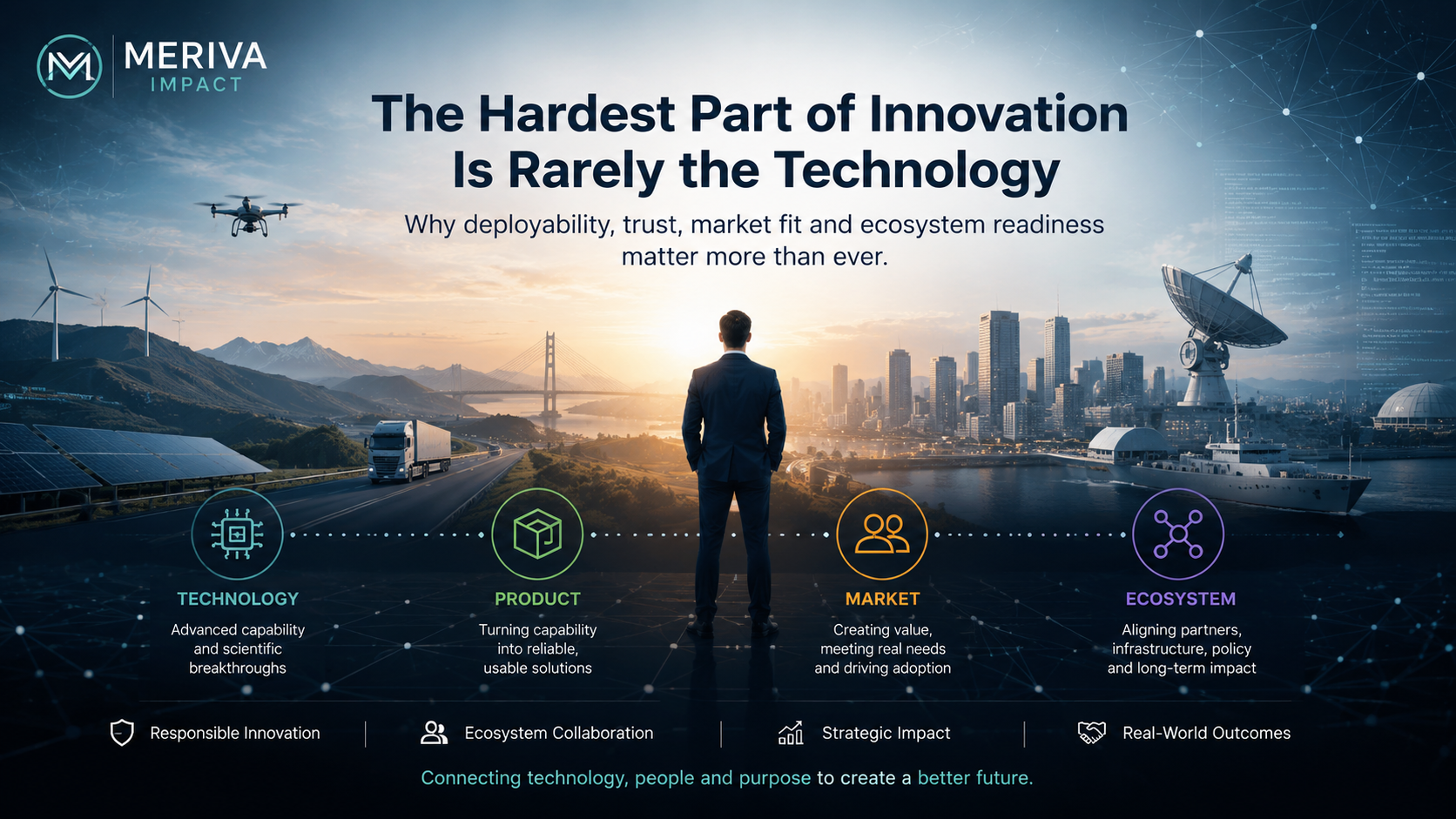
Technology → Product → Market → Ecosystem
Over time, I have found myself thinking about innovation through a broader framework. Technology is only the starting point. Turning capability into meaningful impact requires a much wider balancing act between:
- technical feasibility,
- operational reality,
- commercial viability,
- governance and assurance,
- ecosystem alignment,
- public trust,
- and long-term sustainability.
This is especially visible in sectors such as AI and trustworthy autonomous systems, defence and national security, transport decarbonisation, digital infrastructure, and other complex public-purpose innovation.
Why technically strong ideas fail
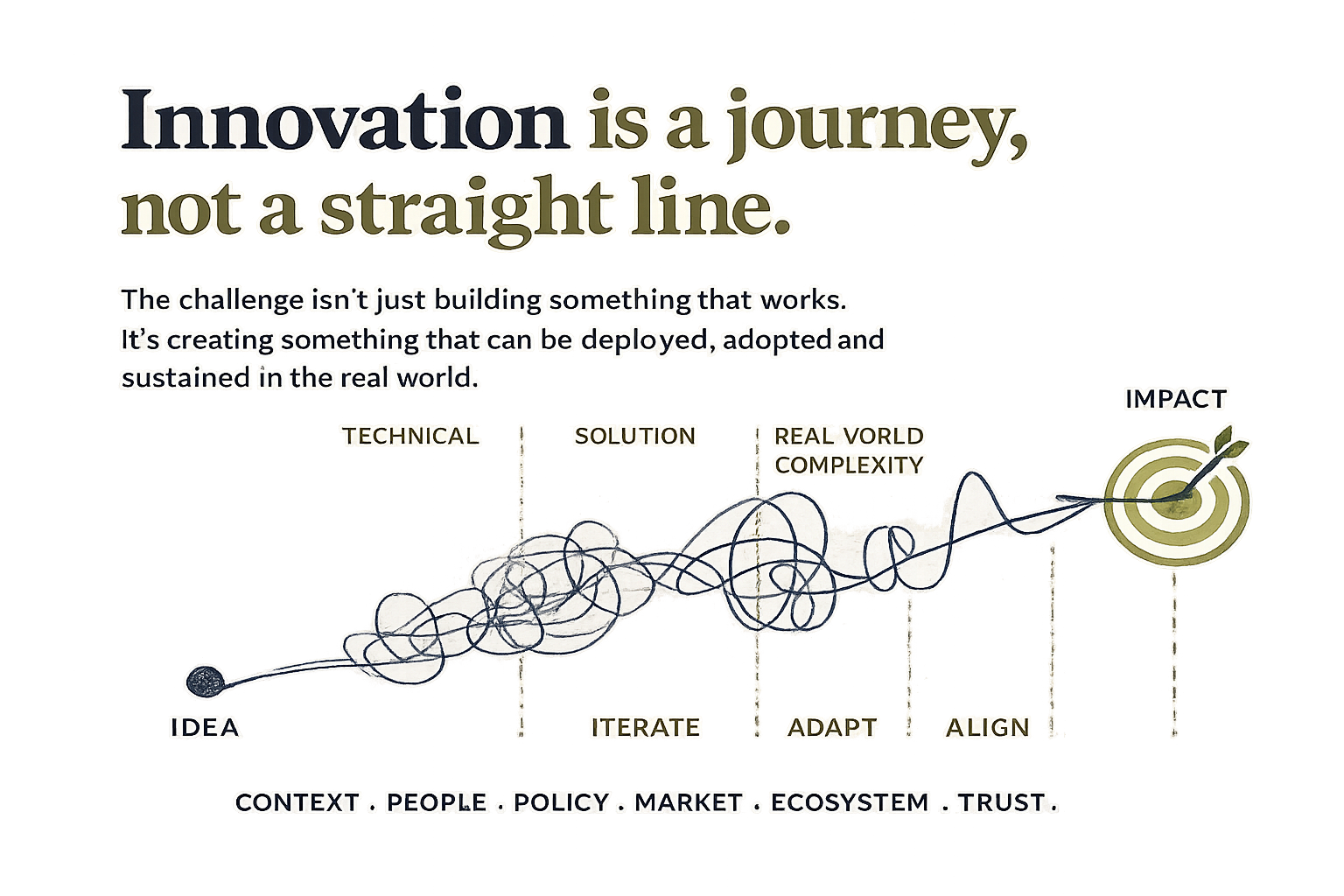
In many cases, technically impressive solutions fail because the surrounding conditions were never properly considered. The technology may work perfectly in isolation, but deployment fails because:
- the operating model is unclear,
- stakeholders are misaligned,
- regulation is immature,
- incentives conflict,
- costs scale badly,
- integration is too complex,
- users do not trust the system,
- or the broader ecosystem is not ready.
What the most successful programmes have in common
At the same time, some of the most successful innovation programmes are not necessarily those with the most advanced technology. They are often the programmes that best balance:
- ambition with practicality,
- innovation with governance,
- experimentation with operational reality,
- and technical capability with ecosystem readiness.
Innovation today rarely happens inside a single organisation. Real impact increasingly depends on aligning government, industry, academia, infrastructure owners, investors, regulators, operators and end users.
Why ecosystem thinking matters at leadership level
That alignment takes deliberate effort. It also requires leaders who can move between technical, operational, commercial and strategic conversations — translating between different stakeholder groups while keeping focus on the overall outcome.
For me, that has become one of the most interesting aspects of innovation leadership. Not simply developing new technology, but helping organisations create credible pathways from emerging capability into deployable, adoptable and sustainable real-world outcomes.
That is increasingly the focus of my work through Meriva Impact.